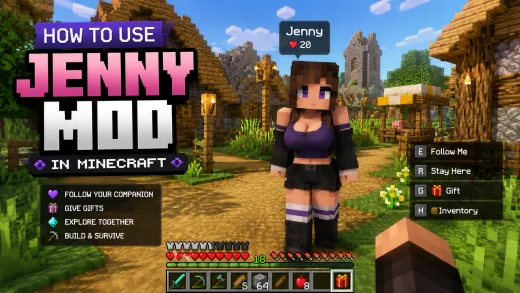
Quick facts
- Mod
- Jenny Mod
- Java version
- Forge 1.12.2
- Bedrock target
- 1.17.0–1.21.71+
- Creator
- Schnurri_tv / SlipperyTum (community)
- Java file
- .jar (Forge)
- Bedrock file
- .mcaddon / .mcpack
- Also searched as
- Jennys mod, Jenny's mod, Jeeny mod, Jenny mod apk
- Not affiliated with
- App Store / Play wrapper apps, fake CurseForge
If you search “how to use jenny mod,” you usually get mixed answers: some focus only on downloading, some focus only on character names, and others skip the actual gameplay loop. This guide is designed to fix that by giving you a practical, non-explicit way to understand the mod as a world system, not just a file.
The goal here is simple: help you play more smoothly with less confusion. You will learn where players usually find Jenny, how each major character fits into gameplay, how to organize exploration, and how to avoid common mistakes that make the mod feel unstable.
Before jumping in, keep three links handy:
- Homepage for site navigation.
- FAQ for short answers and definitions.
- Compatibility guide if your world behaves differently across versions.
Quick Start (Gameplay View)
You can think of Jenny Mod gameplay in four stages:
- Build a stable world setup.
- Locate characters through structured exploration.
- Learn each character’s role and interaction rhythm.
- Expand your world plan with resources, routes, and backup discipline.
Most new players trip at step one by rushing. They stack random mods, wander around, and assume the mod is broken when behavior does not match YouTube clips. Slow down — test one thing at a time.
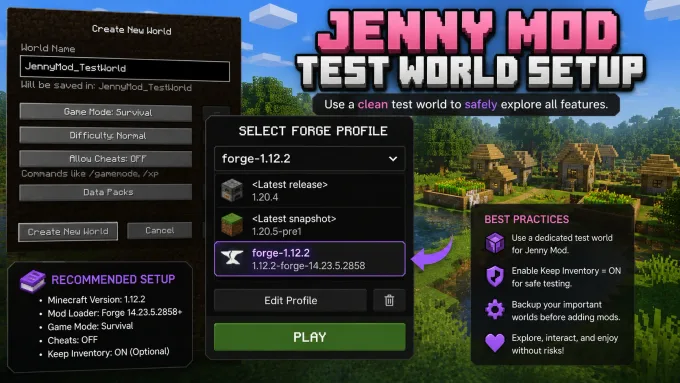
Use a fresh world for first testing. Keep notes about spawn points, structures, and time-of-day conditions where characters appear. Small notes save huge amounts of repeated wandering.
What Jenny Mod Adds to Your World
Jenny Mod is best understood as an interaction-focused layer added to standard Minecraft exploration. Instead of only mining, crafting, and combat, your gameplay loop includes social-style encounters, character-specific behavior patterns, and world events tied to those encounters.
From a systems perspective, the mod modifies how you evaluate locations. A village is no longer only a trade spot. A path is no longer only movement. Structures become potential interaction hubs, and your map becomes a relationship between travel routes and character encounter probability.
This changes pacing. Traditional survival progression rewards resource optimization. Jenny Mod progression rewards both resource optimization and encounter planning. Players who understand this dual pacing adapt quickly.
Another key change is attention management. You are balancing:
- Vanilla progression (tools, food, shelter, danger control).
- Character discovery and interaction timing.
- Mod stability checks and world consistency.
Treat these as a combined strategy and the experience becomes much more coherent.
How to Find Jenny
The most common question is still the most practical one: where do you find Jenny?
There is no universal one-coordinate answer, because spawn behavior can vary by build and world conditions. But there is a repeatable search strategy that works better than random movement.
Step 1: Start with likely populated zones
Begin near villages, roads, and structure-adjacent areas where interaction-heavy mods often place events. Avoid deep wilderness-only routes at first.
Step 2: Search in short loops
Instead of long one-way exploration, use short loops around a central base. This helps with chunk refresh behavior and reduces getting lost during early mapping.
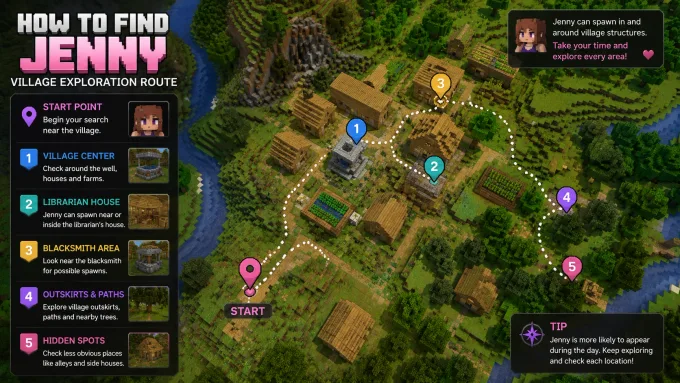
Step 3: Mark high-probability spots
Place visible markers at locations where encounters occur or nearly occur. Even failed checks are useful data because they narrow where to look next.
Step 4: Re-check under different conditions
Some encounter logic can feel condition-sensitive depending on world state and build behavior. Returning later with changed conditions can produce different outcomes.
Step 5: Avoid noisy mod stacks initially
Heavy entity packs and broad AI overhauls can interfere with expected behavior. If discovery is inconsistent, simplify first, verify function, then add complexity.
This method does not guarantee instant success, but it dramatically reduces aimless searching.
Character Overview: Jenny, Allie, Luna, Galath, Bia, Ellie, Bee, Goblin, Slime Girl
Character understanding is where most of the gameplay depth lives. Treat each character as a different “interaction profile” rather than a reskin.
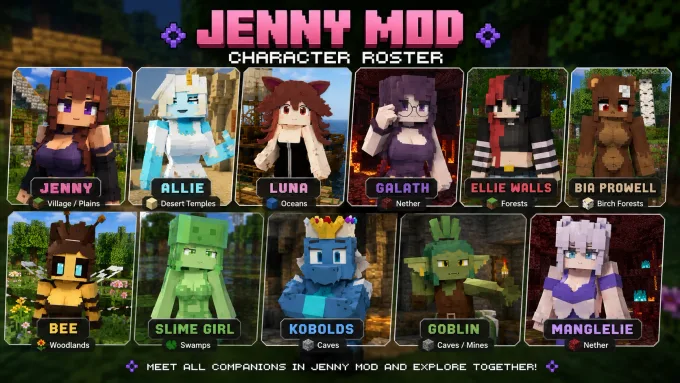
Jenny
Jenny is usually the character to learn first. Her behavior sets the pace for the rest of the mod. New players should get comfortable with Jenny before chasing every other NPC.
Allie
Allie is often approached as a progression character for players who are already comfortable with basic interactions. Expect a slightly different rhythm than Jenny, which encourages adaptation rather than repetition.
Luna
Luna commonly fits players who enjoy exploratory pacing. Encounters with Luna can feel more contextual, rewarding players who map routes and revisit areas thoughtfully.
Galath
Galath usually stands out by changing interaction expectations. Players who copy the same approach used with earlier characters may struggle. Adjusting timing and location logic tends to help.
Bia
Bia often works well for players focusing on consistency and repeated route efficiency. If you like measured loops and predictable world patterns, Bia interactions can feel rewarding.
Ellie
Ellie tends to fit mid-progression worlds where your base, travel tools, and survival routine are already stable. Encounter confidence increases once your world logistics are organized.
Bee
Bee usually encourages mobility and observation. Players who stay stationary too long may feel progress is slow. Active route design is useful here.
Goblin
Goblin interactions often feel most natural when you are already comfortable with environmental awareness and path discipline. Random wandering produces weaker results than structured exploration.
Slime Girl
Slime Girl generally emphasizes timing and world-state awareness. If results are inconsistent, test under controlled conditions and keep logs so you can identify patterns.
The important point: all nine characters are easier to use when you play methodically. “Why is this not spawning?” is often a route design issue, not a character issue.
Core Gameplay Loop
A stable Jenny Mod session usually follows this loop:
- Prepare your base and supplies.
- Run planned exploration routes.
- Trigger or locate interactions.
- Return, document results, and adapt route plans.
- Expand into new areas once current routes become consistent.
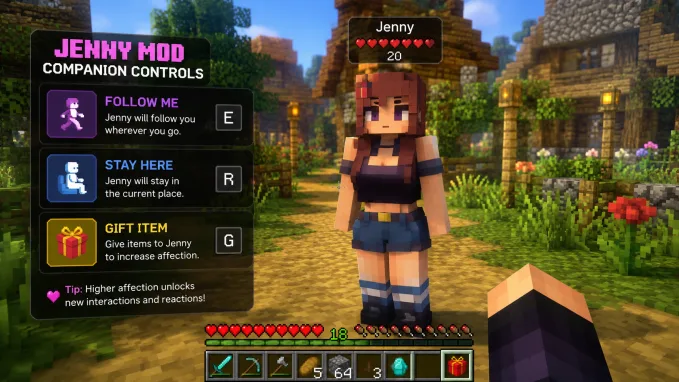
This loop sounds simple, but it works because it controls variables. If you change everything at once, you cannot tell what caused success or failure.
Base Preparation
Your base should support repeated short trips. Keep food, basic tools, and storage organized so each route starts quickly. Avoid overcomplicated starter bases; speed and clarity matter more than aesthetics in early testing.
Route Execution
Choose one primary direction and one backup direction. Run them repeatedly before opening new routes. Repetition reveals encounter patterns faster than broad random exploration.
Result Tracking
After each route, note what happened:
- Encounter yes/no
- Approximate area type
- Time/weather context if relevant
- Any unusual lag or entity behavior
These notes become your private compatibility layer and reduce frustration.
Iteration
Small adjustments beat large resets. Move one route marker, then retest. Change one related setting, then retest. Controlled iteration is how you stabilize gameplay.
Interaction Management and Boundaries
Healthy gameplay with interaction-focused mods depends on player boundaries and session intent. Decide what your current session is for:
- Discovery session (find characters, map routes)
- Progression session (expand world support systems)
- Testing session (check behavior after version or config changes)
Mixing all three in one session can feel chaotic. Clear session intent keeps the mod fun and manageable.
Another boundary is cognitive load. If you are learning multiple characters at once, slow down. Master one or two, then expand. This mirrors how players learn complex automation mods: depth before breadth.
Exploration and Location Strategy
Exploration is the engine of this mod. The better your exploration method, the more consistent your experience.
Use layered maps
Treat your world map as layers:
- Core radius (fast loop around base)
- Mid radius (structured expansion routes)
- Outer radius (experimental scouting)
Most useful encounters early on happen in core and mid layers because revisit frequency is higher.
Build route landmarks
Use clear landmarks so you can replicate successful paths exactly. If you cannot repeat a route, you cannot validate encounter patterns.
Manage travel risk
Do not let exploration greed collapse your survival basics. Keep spare gear and return thresholds. Losing progress to avoidable danger breaks gameplay momentum.
Time-box route runs
Set route duration windows. For example, run 10-15 minute loops and evaluate outcomes. Time-boxing keeps data quality high and reduces random drift.
Economy, Items, and Resource Flow
Even though this mod is interaction-focused, vanilla resource flow still matters. Poor economy planning creates indirect “mod problems” that are actually resource bottlenecks.
Prioritize:
- Food stability for repeated travel.
- Lighting and navigation tools for safer movement.
- Storage organization for fast turnaround.
- Backup equipment for recovery after unexpected deaths.
You do not need endgame gear to enjoy the mod, but you do need consistency. Consistency is what turns occasional encounters into a reliable gameplay routine.
If your world feels messy, simplify item categories and route kits. A clean inventory strategy improves every session.
Difficulty and Progression Planning
Progression with Jenny Mod works best when tied to world maturity.
Early stage
Focus on setup reliability and initial character discovery. Keep mod stack light. Record what works.
Mid stage
Expand character coverage (Jenny, Allie, Luna, Galath, Bia, Ellie, Bee, Goblin, Slime Girl) while improving travel efficiency and base support.
Late stage
Optimize world routines, decorate interaction hubs, and test multiplayer or larger mod stacks if desired.
Players often skip early discipline and jump straight to late-stage ambitions. That usually causes instability and confusion. Good progression is layered, not rushed.
Multiplayer and Shared World Etiquette
Jenny Mod in multiplayer adds social logistics on top of technical logistics. The world can remain smooth if players agree on rules before starting.
Recommended shared-world rules:
- Agree on version and loader lock before world launch.
- Document any mod changes in a shared note.
- Avoid unilateral updates mid-session.
- Respect personal play zones and route markers.
- Keep backups before major changes.
Etiquette matters because one player’s spontaneous mod swap can break everyone else’s expected behavior.
If multiplayer feels unstable, reproduce the same scenario in singleplayer first. That isolates whether issues come from network sync or base configuration.
Common User Mistakes
Most frustration comes from a short list of repeated errors.
Mistake 1: Skipping compatibility checks
Players install first and verify later. This creates avoidable crashes and misdiagnoses.
Mistake 2: Using random mirrors
Unclear file origin creates both trust and functionality problems. Always validate source context.
Mistake 3: Testing in an important world
A fresh test world is safer for initial validation. Important worlds should be protected until behavior is confirmed.
Mistake 4: Changing too many variables at once
When you update version, loader, and several mods together, debugging becomes difficult.
Mistake 5: No documentation habit
Without notes, users repeat failed routes and lose confidence. A tiny log file solves this.
Session Templates You Can Reuse
To make gameplay smoother, use simple session templates.
Template A: Discovery Session (30-45 min)
- Check base supplies.
- Run two core routes.
- Record encounter outcomes.
- Adjust one variable only.
Template B: Character Expansion Session (45-60 min)
- Pick one new character target.
- Travel through mapped landmarks only.
- Compare results to prior notes.
- Save and backup after stable success.
Template C: Stability Session (20-30 min)
- No exploration expansion.
- Retest known successful routes.
- Confirm behavior consistency.
- End with backup and log update.
Templates remove decision fatigue and keep progress measurable.
If You Cannot Find Characters Consistently
When consistency drops, use a reset framework:
- Confirm version-loader match.
- Temporarily reduce unrelated mod complexity.
- Use one route, one character goal.
- Retest across multiple short loops.
- Expand only after repeatable success.
This framework converts “nothing works” into a sequence of diagnostic steps. It also prevents unnecessary full reinstalls.
If technical errors persist, use Jenny Mod Not Working Fixes. If concerns are about trust or suspicious files, use Is Jenny Mod Safe?.
Linking Gameplay to Compatibility and Safety
Gameplay quality is built on two foundations:
- Compatibility foundation: version, loader, dependencies.
- Safety foundation: source trust and scan discipline.
Ignoring either foundation makes gameplay advice feel unreliable. That is why this guide intentionally links to:
Use gameplay guidance with those foundations and your sessions will feel far more stable.
Practical Progress Plan for New Players
If you are starting from zero, use this seven-day progression outline:
Day 1: Build test world and validate core function.
Day 2: Focus only on finding Jenny with mapped loops.
Day 3: Add one additional character target (Allie or Luna).
Day 4: Improve base logistics and route efficiency.
Day 5: Expand character goals (Galath, Bia, Ellie).
Day 6: Explore wider routes (Bee, Goblin, Slime Girl).
Day 7: Review logs, cleanup world organization, back up.
This plan turns scattered trial-and-error into measurable progress.
Final Takeaway
Using Jenny Mod well is less about secret commands and more about disciplined world management. Find Jenny through structured exploration, learn each character profile one by one, and maintain version/safety fundamentals in the background.
When players say the mod feels “inconsistent,” the cause is often inconsistent process. When process is stable, gameplay becomes stable.
For next steps:
- Re-check homepage links.
- Keep FAQ open for quick reminders.
- Use not working fixes if behavior breaks after updates.
The mod becomes much more enjoyable once your routes, notes, and session goals are clear.
Frequently Asked Questions
What is the fastest beginner path?
Use a fresh world, confirm your version first, and focus on finding Jenny before chasing every other character. Less overload, fewer false “broken mod” moments.
Do I need to learn every character immediately?
No. Start with Jenny, then add Allie or Luna, and expand gradually to Galath, Bia, Ellie, Bee, Goblin, and Slime Girl. Depth-first learning is more effective.
Why do encounters feel random sometimes?
Perceived randomness often comes from route inconsistency, mixed world conditions, or too many variables changed at once. Controlled loops and notes usually fix this.
Is multiplayer recommended for beginners?
Singleplayer is easier for first learning because fewer sync variables are involved. Move to multiplayer after your setup is stable and documented.
Which guide should I read after this?
Read Jenny Mod Not Working Fixes for technical issues and Is Jenny Mod Safe? for trust and scan best practices.