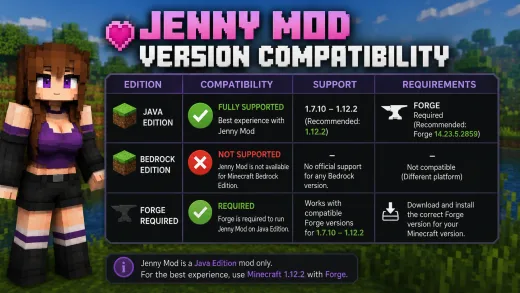
Quick facts
- Mod
- Jenny Mod
- Java version
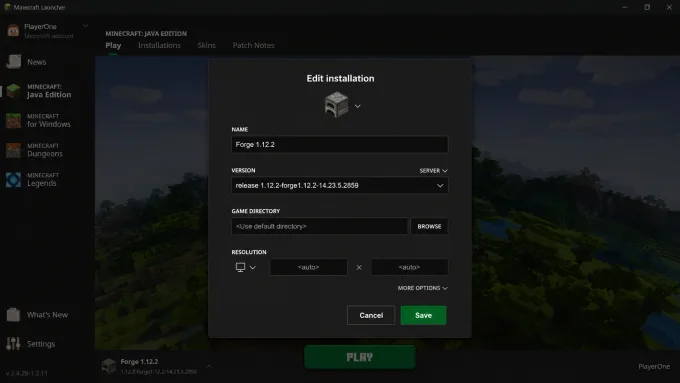
- Forge 1.12.2
- Bedrock target
- 1.17.0–1.21.71+
- Creator
- Schnurri_tv / SlipperyTum (community)
- Java file
- .jar (Forge)
- Bedrock file
- .mcaddon / .mcpack
- Also searched as
- Jennys mod, Jenny's mod, Jeeny mod, Jenny mod apk
- Not affiliated with
- App Store / Play wrapper apps, fake CurseForge
Minecraft mod compatibility sounds simple until you start mixing game editions, mod loaders, and version-specific dependencies. Jenny Mod is one of the best examples of this complexity. People search for “jenny mod 1.21,” “jenny mod 1.20.1,” “jenny mod mcpe,” and “jenny mod bedrock” in the same session, but those terms point to very different technical realities.
This guide gives a clean compatibility map so you can quickly understand what is stable, what is possible with compromises, and what is mostly marketing language. If you need a starting point for downloads and navigation, use the homepage. If you want common troubleshooting after version mismatches, jump to the fixes guide. For general safety checks around files and fake app claims, read Is Jenny Mod Safe?.
Quick Answer
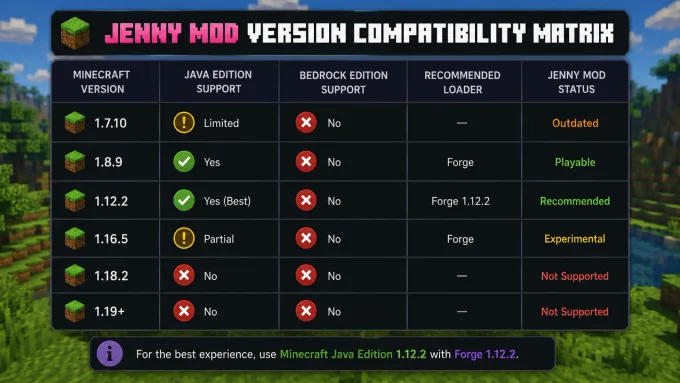
Jenny Mod compatibility is strongest on Minecraft Java 1.12.2 with Forge-based setups. Community attempts for 1.20.1 exist as secondary options, but they vary in quality and are less consistent. Claims for 1.21, Bedrock, and MCPE often refer to alternative formats rather than the same Java mod behavior.
If your goal is predictable gameplay behavior, keep your expectations centered around Java Edition compatibility patterns. If your goal is “latest version at all costs,” be ready for partial features, missing dependencies, and frequent breakage.
Why Version Compatibility Is Confusing
Compatibility confusion around Jenny Mod happens for five recurring reasons.
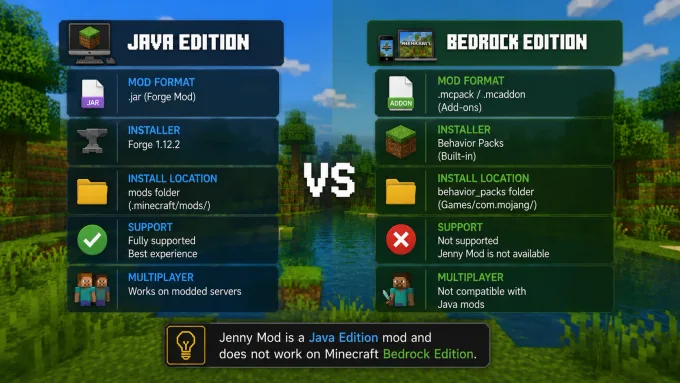
First, many guides say “Minecraft” like it is one thing. Java Edition and Bedrock Edition use different file types. A Java mod is not a Bedrock behavior pack — swapping names does not make them interchangeable.
Second, search engines reward broad keywords. A post titled “Jenny Mod 1.21 MCPE Bedrock” may rank even when the downloadable file is only tested on Java 1.12.2. The title reflects search demand, not real compatibility depth.
Third, mod loaders introduce another layer. Forge and Fabric are not interchangeable at runtime. A build packaged for one loader may fail instantly on the other even if the Minecraft game version number is correct.
Fourth, the term “port” is used loosely. Some projects are true code ports that adapt logic for newer APIs. Others are light repacks with renamed files and minimal testing. Both may be labeled “1.20.1 compatible.”
Fifth, community mirrors may remove context. A file that originally had a narrow compatibility warning gets reposted without that warning, so users assume universal support.
Understanding these five causes helps you evaluate claims before you lose time in trial-and-error cycles.
Primary Support: Jenny Mod 1.12.2
When people say “the stable Jenny Mod version,” they usually mean Java on 1.12.2. That is not random nostalgia — years of Forge mods, packs, and forum posts are built around that release.
From a compatibility perspective, 1.12.2 gives three major advantages.
The first advantage is API stability. Older Forge APIs for 1.12.2 are deeply documented and have predictable integration patterns. That lowers the risk of sudden breaks from upstream API changes.
The second advantage is dependency availability. If a build expects specific helper libraries common in older Forge stacks, they are easier to find in known repositories and community archives.
The third advantage is troubleshooting maturity. Most recurring crash patterns on 1.12.2 have already been seen by many users, so known fixes are easier to locate in FAQs and community notes.
None of that means 1.12.2 is perfect. Older versions can still crash from bad file combinations, duplicate mods, or memory limits. But relative to newer experimental ports, it remains the most predictable path for users who prioritize consistency over novelty.
For players planning long-term worlds, predictability matters more than raw version number. A stable environment saves more time than upgrading every few weeks to chase a new label.
Secondary Support: Jenny Mod 1.20.1
Interest in 1.20.1 is understandable. Players want modern world generation, newer quality-of-life systems, and the ability to keep a current-looking stack. That demand has produced secondary Jenny Mod builds and community ports targeting 1.20.1.
The key word is secondary. In many cases, 1.20.1 support exists, but with caveats:
- Feature parity may be incomplete compared to older baseline behavior.
- Dependency chains may be narrower and more fragile.
- Loader-specific assumptions are stricter.
- Update frequency depends on smaller maintainers.
When evaluating a 1.20.1 claim, ask whether the source provides explicit scope: what works, what is disabled, and what changed. A trustworthy release usually documents known issues instead of promising universal compatibility.
Another common pattern on 1.20.1 is partial success. The mod may launch and appear functional in a light test world, but break under larger mod stacks, custom shaders, or server synchronization. This does not always mean the build is “fake”; it often means compatibility testing depth was limited.
If you want to try 1.20.1, treat it as a managed experiment. Keep backups, keep worlds separated by version, and avoid assuming that every old guide applies line-by-line.
What About Minecraft 1.21?
Search demand for 1.21 is high, but real compatibility maturity is currently low and uneven. New Minecraft releases can alter internals that affect mod hooks, mappings, and loader updates. Even when loader ecosystems move quickly, individual mods still need adaptation and testing.
For Jenny Mod specifically, many “1.21 ready” claims appear before sustained testing evidence exists. Some releases may boot, but booting is not the same as complete gameplay compatibility. The difference between “loads in menu” and “stable through full sessions” is large.
A practical way to think about 1.21 today:
- Possible in isolated cases.
- Inconsistent in broad use.
- High maintenance for users who want zero friction.
If your priority is reliability, 1.21 is usually not the first recommendation yet. If your priority is experimentation, 1.21 can be interesting, but you should assume ongoing adjustments.
Java Edition vs Bedrock vs MCPE
This section matters more than any single version number. Many compatibility misunderstandings come from mixing platform terms.
Java Edition
Traditional Jenny Mod discussions are rooted in Java Edition. Java mods are built against Java APIs, Java loaders, and Java runtime assumptions. When a guide references Forge or Fabric, it is almost always about Java Edition.
Bedrock Edition
Bedrock uses a different architecture and different extension formats. It supports add-ons and behavior/resource packs, but that is not equivalent to dropping in a Java .jar mod. Some creators make Bedrock content inspired by Java mod concepts, but it is not a one-to-one execution path.
MCPE
MCPE is effectively the mobile branch name many users still use for Bedrock on phones/tablets. So when users ask “jenny mod mcpe,” they usually mean “is there a mobile-friendly equivalent?” not “can I run a Java Forge jar directly on Android Bedrock?”
The answer is straightforward: direct native compatibility is not the norm. If a mobile file claims full parity with Java behavior, inspect that claim carefully.
Forge vs Fabric Compatibility
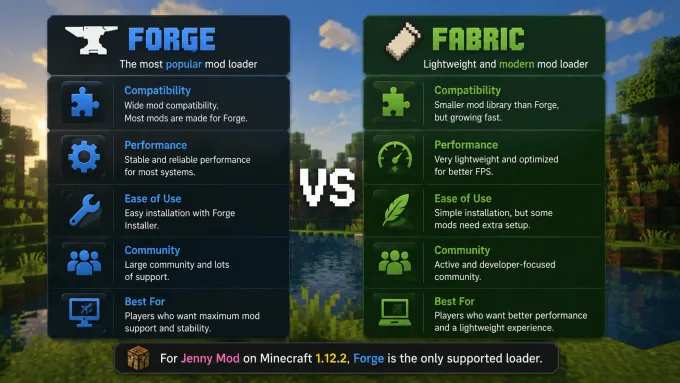
Forge and Fabric are both mod loaders, but they are not interchangeable. A mod built for one will not run on the other without a separate port.
For Jenny Mod compatibility checks, loader mismatch is one of the most common failure sources. Users often focus on Minecraft version while overlooking loader requirements. For example, a “1.20.1” label without loader context is incomplete and potentially misleading.
In practice:
- Forge remains the historically dominant loader context for older Jenny Mod conversations, especially 1.12.2.
- Fabric-related claims exist in community spaces but require careful verification of exact build origin and support scope.
- Mixed-loader stacks increase troubleshooting complexity quickly.
The safest approach is to treat loader choice as a first-order compatibility decision, not a secondary setting.
Singleplayer, Multiplayer, and Server Reality
Compatibility is not just “does it launch.” Runtime context matters:
- A mod can work in singleplayer and fail on a dedicated server.
- A client-only behavior can conflict with synchronized server logic.
- A setup that feels smooth in a fresh world can break under older saves.
Server operators should be especially strict about version matching and test environments. If client and server expectations diverge, users see desync, missing entities, or frequent disconnects. Even when a mod claims broad support, server contexts expose issues faster because more systems are active at once.
For most players: test in a fresh world before committing to a long save. For server owners: try on a test server before rolling it out to everyone.
How to Evaluate a Compatibility Claim
You can quickly evaluate most compatibility claims with a simple checklist.
- Edition clarity: Does the source explicitly say Java or Bedrock?
- Version precision: Is the target version specific (for example 1.12.2 or 1.20.1), not just “latest”?
- Loader precision: Does it name Forge or Fabric, and required versions?
- Scope statement: Does it list known limits and incomplete areas?
- Maintenance signal: Is there recent update activity or issue tracking?
- Community consistency: Do reports from users align on what works?
A reliable source usually answers all six. If only one or two are answered, expect surprises.
This is also where misinformation gets filtered out. Broad SEO-style pages often fail checklist items 3 and 4. Community-maintained release notes, by contrast, usually provide sharper technical boundaries.
Recommended Version Strategy
If you want a practical strategy instead of endless comparison threads, use this layered model.
Strategy A: Stability-first
Choose Java 1.12.2 with well-documented loader pairing. Keep a compact mod list. Avoid frequent version jumps. This strategy is best for users who want predictable sessions.
Strategy B: Balanced modern setup
Try a vetted 1.20.1-compatible build with explicit documentation. Keep strong backups and avoid mixing too many experimental dependencies at once. This strategy gives newer game feel while controlling risk.
Strategy C: Experimental latest
Explore 1.21 claims only if you are comfortable debugging and rebuilding your stack often. Keep expectations realistic and isolate test worlds from long-term saves.
No strategy is universally “best.” The right strategy depends on your tolerance for troubleshooting and your goal for that world.
Common Compatibility Myths
Myth one: “If two files say 1.20.1, they are compatible together.”
Reality: Loader versions and dependency versions can still conflict.
Myth two: “Bedrock and Java are basically the same now.”
Reality: They share branding, not full mod runtime compatibility.
Myth three: “Latest Minecraft version means best experience.”
Reality: Newer Minecraft versions can break more often while mods are still catching up.
Myth four: “If it launches once, compatibility is solved.”
Reality: Long-session stability, save integrity, and multiplayer behavior still need verification.
Myth five: “All ports are equal.”
Reality: Port quality varies with maintenance effort, code depth, and test coverage.
Internal Linking Map for New Readers
If you just arrived and want to continue learning without digging through random search results:
- Start with the main homepage for the current site structure.
- Use the FAQ page for short answers to recurring concerns.
- Read How to Use Jenny Mod in Minecraft for gameplay-focused guidance.
- Read Jenny Mod Not Working Fixes if your setup fails after a version or loader change.
- Read Is Jenny Mod Safe? before downloading from any third-party page.
This path saves time because it separates compatibility from safety and from gameplay usage, instead of mixing all three concerns into one overloaded thread.
Long-Term Maintenance Considerations
Compatibility is not a one-time choice. Over months, small updates in launcher behavior, Java runtime versions, and loader ecosystems can shift what is stable.
For long-lived setups, keep a lightweight maintenance routine:
- Record your working version matrix in plain text.
- Keep archived copies of known-good files.
- Avoid changing multiple core components in one session.
- Test after each change before proceeding.
- Keep world backups before major transitions.
This routine helps both newcomers and experienced users avoid “mystery breakages.” Most compatibility failures are not random; they come from undocumented changes and unclear version boundaries.
Final Compatibility Matrix (Practical View)
You can treat this matrix as a realistic expectation guide:
- Java 1.12.2 + Forge: Highest consistency, broad historical guidance.
- Java 1.20.1 (community ports): Usable for some users, variable stability.
- Java 1.21: Experimental, uneven maintenance.
- Bedrock/MCPE direct Java mod parity: Generally not native; often alternative content formats.
- Forge/Fabric cross-use without dedicated builds: Not expected to work.
The main takeaway is simple: version number alone does not define compatibility. Edition, loader, dependencies, and maintenance quality together determine whether your experience is smooth or frustrating.
Frequently Asked Questions
Is Jenny Mod 1.12.2 still worth using in 2026?
Yes — for most players, 1.12.2 is still the steadiest choice because guides and forum answers are everywhere. Newer versions can be fun but need more upkeep.
Why do so many sites advertise Jenny Mod 1.21 if support is limited?
Because latest-version keywords attract clicks. Some listings are optimistic placeholders, and some are experimental builds presented as finished products. Always look for concrete scope and update notes.
Can I run the same Jenny Mod file on Java and Bedrock?
No. Java and Bedrock are different under the hood. Similar content may exist in both, but not as the same file with identical behavior.
Is 1.20.1 a bad choice?
Not necessarily. It can be a good secondary choice if your source is transparent, your loader is correct, and you accept that compatibility may not be as mature as 1.12.2.
Where should I go next?
Use How to Use Jenny Mod in Minecraft for gameplay guidance, Jenny Mod Not Working Fixes for technical errors, and Is Jenny Mod Safe? for file trust and scam-avoidance checks.